Ermin Hamidovic: prog-metal mixer, Systematic Mixing Guide author, URM contributor
Ermin Hamidovic mixed Animals as Leaders and Periphery-era prog records, and wrote The Systematic Mixing Guide that defines the djent mixing approach. What strings fit his rhythm-guitar lane.
Reviewed by the Change Your Strings editorial team ·
Ermin Hamidovic is the Australian mixer and mastering engineer behind Animals as Leaders' The Joy of Motion, Intervals, and Scale the Summit, plus author of The Systematic Mixing Guide, the production book that defines the modern djent mixing method. His lane is 7- and 8-string prog-metal and djent in Drop A, Drop G, and lower. String choices that fit: heavy-gauge 7-string sets (.010–.062) and 8-string extended-range sets tuned to drop F or below.
Who Ermin Hamidovic is
Ermin Hamidovic is an Australian mixer and mastering engineer whose catalog is the prog-metal and djent production lane's cleanest reference point for how modern extended-range metal is mixed. Animals as Leaders' The Joy of Motion, Intervals, Scale the Summit, Periphery-era material, The Contortionist, Textures, the bands whose musical identity is built on 7- and 8-string guitar work run through his mixes at a disproportionate rate.
He is also the author of The Systematic Mixing Guide, a book that documents his approach to mixing and mastering modern metal. Unlike the video-first URM platform, Systematic is text-first reference material, diagrams, EQ curves, compression chains, routing decisions explained in print. It's the djent producer's equivalent of a technical manual, and it is widely cited.
His ongoing studio is Systematic Productions, based in Australia. He is an active musician on bass and guitar, which differentiates him from pure-engineering peers the same way Eyal Levi's Dååth guitar background does, he mixes from the perspective of someone who has also been in the tracking seat.
This page is the guitar-string context for his production lane. We describe the strings that fit his production style; nothing here is a direct endorsement claim absent sourced citation.
Production signatures
Four things identify a Hamidovic-era prog-metal mix:
- Extended-range low-string clarity. 7- and 8-string low strings in Drop A, Drop G, and below occupy frequency real estate that overlaps with bass guitar and kick drum. His mixes consistently separate those sources, the extended-range guitar is audible as a guitar, not as an indistinct low rumble. That separation starts at tracking and specifically at string gauge.
- Programmed-drum integration that doesn't sound programmed. A large share of prog-metal and djent records use edited or programmed drums. His mixes avoid the "clicky fake drum" trap by treating the guitar track's attack transients as part of the drum's rhythmic environment, which requires clean, fresh-string guitar attack.
- Instrumental-band frequency balance. Animals as Leaders, Intervals, and Scale the Summit are (or were) largely instrumental. Without vocals as the midrange anchor, the guitar and bass have to carry the frequency real estate a vocalist would normally occupy. Gauge decisions that support rich harmonic content (fresh strings, defined pick attack) matter more in instrumental contexts than in vocal-forward metalcore.
- Systematic approach as signal. His book and mixing content emphasize reproducible technique over gear-chasing. Records mixed in his lane tend to sound consistent across multiple albums from different bands, the production reference is the constant, not any single artist's gear. Gauge and string choices that fit his lane are the ones that support that reproducibility.
Strings that fit the Systematic-era prog-metal lane
7-string Drop A / Drop G (25.5" scale)
.010–.062 is the anchor 7-string gauge. .010–.059 if the low string feels too stiff in Drop A. Ernie Ball Slinky Cobalt 7-string (2730), D'Addario NYXL 7-string, Elixir Nanoweb 7-string variants all fit.
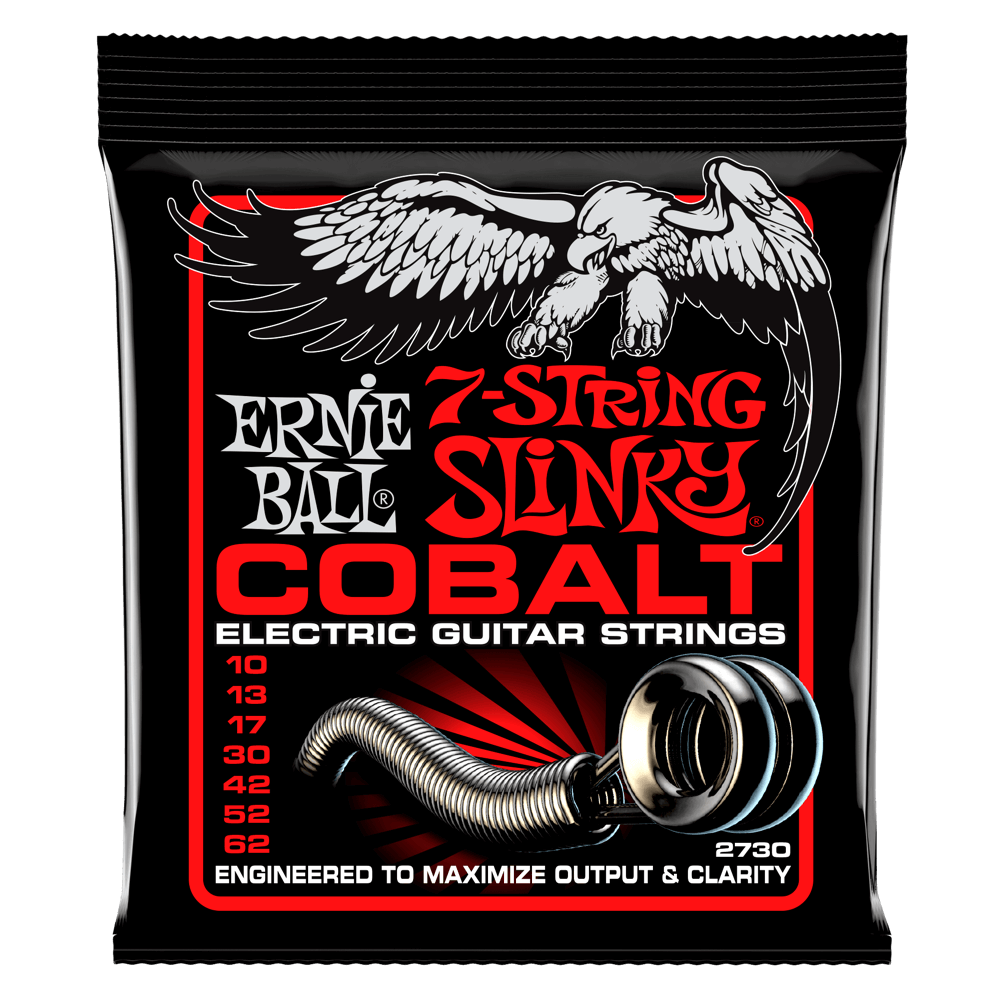
Slinky Cobalt 7-String (.010–.062)
Why this one: The Cobalt 7-string set that defines the Holcomb / Richardson / Merrow lane, which is the same sonic space Hamidovic mixes in. Defined low-string attack lets the mix engineer cut a kick-and-bass pocket without fighting the guitar.
8-string Drop E / Drop D (26.5"–28" scale)
Custom sets running up to .072–.074 on the low F#. Manufacturers stock several 8-string options (Ernie Ball 2625, D'Addario NYXL 8-string); many players build custom from singles.
6-string Drop B or lower (for the prog-metal 6-string lane)
.012–.056 Not Even Slinky Cobalt or equivalent. The heavier end of the 6-string Cobalt family.
Coated for long-form tracking
Instrumental prog-metal records often take weeks per tracking phase. Coated strings (Elixir Nanoweb, Ernie Ball Paradigm) outlast the tracking window without requiring a string-age audit mid-session.
Why the Systematic lane rewards instrument-level clarity
Vocal-forward metal mixes can cover for less-than-perfect guitar tracking by letting the vocalist carry the melodic foreground. Instrumental prog-metal cannot. Every choice at the tracking stage, pickup height, string gauge, string age, pick thickness, amp choice, carries more weight in the final mix because there's no vocal melody to distract from a weak rhythm attack or a smeared low note.
Hamidovic's published writing and mixing content repeatedly points at this. The mix decisions he describes assume a tracking source that is already tight, musical, and well-intonated. Gauge choices that support that assumption are the ones that fit his lane; gauge choices that require the mixer to compensate are the ones that don't.
Next steps
- URM roster: Joey Sturgis (metalcore), Joel Wanasek (metalcore/crossover), Eyal Levi (death metal).
- Prog-metal adjacent: Adam "Nolly" Getgood (Periphery producer and co-mixer with Hamidovic on several records).
- Genre pages: djent in Drop A, prog-metal in Drop C.
- Related artist rigs: Mark Holcomb (Periphery), Jason Richardson, Keith Merrow, Wes Hauch.