Joey Sturgis: metalcore producer, plugin developer, tone architect
Joey Sturgis produced a generation of metalcore, Asking Alexandria, Of Mice & Men, Miss May I, Attack Attack!. What strings fit his rhythm-guitar lane.
Reviewed by the Change Your Strings editorial team ·
Joey Sturgis produced the 2008–2016 metalcore sound that defined a generation, Asking Alexandria, Of Mice & Men, Miss May I, Attack Attack!. His rhythm-guitar formula: tight gates, quad-tracked rhythms, and gauges heavy enough to hold Drop C or below without flab. Strings in his lane: .011–.054 minimum for Drop C on 25.5" guitars, 7-string sets (9–62, 10–59) for Drop G material.
Who Joey Sturgis is
Joey Sturgis produced the metalcore and post-hardcore records that defined the 2008–2016 scene. Asking Alexandria's Stand Up and Scream and Reckless & Relentless, Of Mice & Men's The Flood, Miss May I's Apologies Are for the Weak, Attack Attack!'s self-titled, the I See Stars catalog, Born of Osiris' The Discovery, and early We Came As Romans, among many others. A generation of Warped Tour guitarists and drummers processed through one mixing philosophy.
He is a producer-engineer-mixer, not a touring musician. His ongoing commercial entity is Joey Sturgis Tones (JST), a plugin company, amp simulators, drum sample libraries, utility plugins like Bus Glue and Gain Reduction Deluxe. URM Academy, which he co-runs with Eyal Levi, educates the next generation of metal producers.
Sturgis has been generous about production technique publicly, podcasts, YouTube, URM content, but specific string-brand preferences for his own tracking aren't the focus of that material. Where he has cited specific gear directly, we quote it. Where he hasn't, the recommendations below are editorial analysis of what fits his production lane, not direct endorsement claims.
What Sturgis has said about strings
Both quotes below come from publicly-indexed primary sources. We don't publish attributions we can't cite.
Sturgis asked in 2016 whether he had any gear endorsements. Strings made the list, not as a tone preference, but as a recurring consumable of tracking metalcore records at volume.
“No, but I wish I had some companies behind me. I would really like drum heads, strings, and guitars. Those are the things that are always giving me a fucking headache.”
The operational read: a producer tracking 40–60 records a year budgets a set for every tracking day. For the Drop C lane his catalog lives in, that's a .011–.054 nickel-plated set, the gauge below fits that context precisely.
Sturgis on a Gearspace thread about his bass processing approach. Intonation and editing as the dealbreakers, fresh strings are the enabling condition for both.
“Some notes can have a higher RMS value and become louder in sections where it shouldn't. You have to monitor or listen for these situations. The big deal breaker with bass is intonation and editing. If you nail those two things, the tone is easy to create.”
Bass intonation under pick attack is the same physics problem Hetfield was describing on the guitar side. Fresh strings hold pitch under the transient; dead strings smear it. For metalcore bass in Drop C / Drop B territory, the gauge has to hold tension and the wrap has to still ring, which means changing them often, not buying a heavier set and leaving it on.
Strings that fit the Sturgis-era metalcore lane
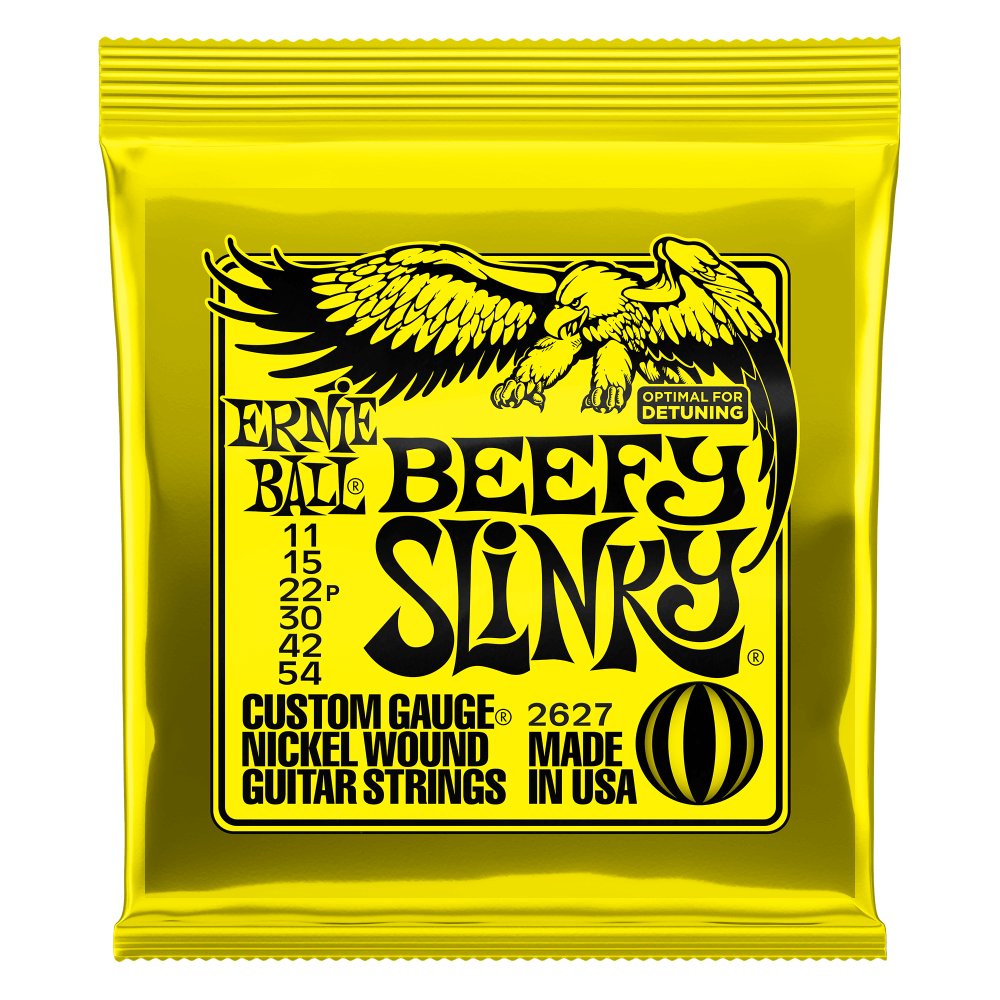
Beefy Slinky (.011–.054)
Why this one: Drop C and Drop C# entry-point gauge on a 25.5-inch scale. The lane Sturgis is describing when he calls strings a recurring tracking-session consumable.

Not Even Slinky Cobalt (.012–.056)
Why this one: Heavier-gauge Cobalt for Drop B material, the tuning Sturgis's heavier catalog (Born of Osiris, Whitechapel-adjacent) lives in. Cobalt wrap holds upper-midrange attack longer than nickel across a tracking week.
Drop C / Drop C# (6-string, 25.5" scale). .011–.054 nickel-plated steel is the minimum.
Drop B / Drop A# (6-string, 25.5" scale). .012–.056 or a 7-string set played as a 6-string with the low B as your lowest. The .060-territory low string is where 25.5" scale meets Drop B reasonably.
Drop G / Drop F# territory (7-string, 26.5"+ scale). 7-string .009–.062 or .010–.059 sets. Multi-scale or 27"+ guitars handle this better than a standard 25.5" 7-string.
Coated for session work. Every Sturgis-era record required multiple days of tracking. Coated strings (Elixir Nanoweb, Ernie Ball Paradigm, D'Addario XT) survive sweat and fret-wear across a tracking session in a way uncoated sets don't.
Production signatures
Four things identify a Sturgis-era metalcore production:
-
Ultra-tight rhythm gating. The signature "chuckachucka", palm-muted 16th-note rhythms with zero bleed between notes, is only possible if the gate is aggressive and the picking is clean. String choice enables or breaks this; worn strings lose attack definition and the gate eats the note instead of letting it bloom.
-
Quad-tracked rhythm guitars. Two takes hard-panned left, two takes hard-panned right. Four takes requires four tracking passes, which requires strings that can survive four consecutive performances without going flat.
-
Breakdown tonality. The low-string chugs in the breakdown sections of these records sit in the 80–160 Hz range where bass guitar also lives. Gauge choice determines whether those chugs have musical pitch or just low-frequency thud.
-
"Scene" lead tones. Bright, forward, compressed lead tones in the chorus sections, often in the Drop C or Drop B territory on the low string but played high on the neck. Nickel-plated steel with fresh strings is the lane.
Why picking attack matters more than gauge
Sturgis's published production content emphasizes this repeatedly: the bedroom-forum belief that heavier strings automatically equal tighter tone is wrong. Heavier strings give you pitch stability in lower tunings; they don't give you tightness. Tightness comes from:
-
Picking technique. Firm, consistent attack; muted palm anchor.
-
Gate calibration. Aggressive enough to cut bleed, lenient enough to let the attack through.
-
Fresh strings. Dead strings lose the upper-midrange content that the gate uses to trigger correctly.
String gauge is a floor condition (heavy enough to hold the tuning) not a quality condition (heavier = better tone). Get the gauge right for the tuning; then move on to the actual variables.
Next steps
-
Genre pages: metalcore in Drop C, metalcore in Drop B.
-
Related producer pages: Drew Fulk (modern metalcore adjacent), Andy Sneap (heavier metal side), Adam "Nolly" Getgood (prog/djent side).
- If you want the JST plugin context without buying plugins: the gauge + gate + fresh-strings formula works with any high-gain amp sim.