Andy Sneap's guitar tone: strings, gauges, and the production lane
Andy Sneap is a British metal producer and touring guitarist for Judas Priest. What strings fit his production style, editorial analysis, sourced where possible.
Reviewed by the Change Your Strings editorial team ·
Andy Sneap is a British metal producer and touring guitarist for Judas Priest (since 2018). His production lane, dense, tight modern-metal rhythm guitar with audible pick-attack definition, pairs best with nickel-plated-steel sets in .010–.046 or .010–.052 for E/Eb standard, and .011–.054 for Drop C-tuned material. Hex-core rounds for tightness; coated sets for long tracking sessions.
Strings in Andy Sneap's lane
Editorial fit for this producer's sonic lane
Who Andy Sneap is
Andy Sneap is a British heavy metal producer and guitarist who has shaped the sound of modern metal since the late 1990s. His production credits read like a survey course of the genre, Machine Head's Through the Ashes of Empires, multiple Megadeth records, Accept's entire post-2010 catalog, Judas Priest's Firepower, Testament's Brotherhood of the Snake and Titans of Creation, Exodus, Nevermore, Arch Enemy, and Saxon, among many others. Since 2018, he has also toured as Judas Priest's second guitarist alongside Richie Faulkner.
He runs his own studio, The Backstage, in Derbyshire. Before production fully took over, he was the founding guitarist of Sabbat and later Hell. All of that means: when he makes a call about how a rhythm guitar should sound on a record, the call comes from someone who has played the part himself, on stage, in front of the metal audience that will judge the record.
Production signatures
Three things define a Sneap-produced metal record:
- Rhythm-guitar tightness. The palm-mute chugs are audible and separable. The low end is present but never flabby. That tightness is the interaction of a tight gate, disciplined picking, and gauges heavy enough to stop the low string from losing pitch on the attack.
- Midrange definition. Sneap's records don't scoop the midrange the way the early-2000s "recto-scooped" metal records did. The guitars cut. String choice matters here, nickel-plated steel in fresh condition, not worn-out sets, is how you get the upper mids to speak.
- Pre-production discipline. Sneap is publicly on record, on his forum, in podcasts, in interviews, about pre-production: get the song right, get the performance right, before you get to amp tone. That philosophy carries into strings: fresh strings at every tracking day, gauge chosen for the tuning, no excuses.
Strings that fit the Sneap lane
These are editorial recommendations, strings that fit his production style, not an endorsement claim. If you're trying to record a metal rhythm guitar track that would sit in a Sneap-adjacent mix, these are the gauge families to start from:
E standard / Eb standard rhythm
.010–.046 nickel-plated-steel sets. Ernie Ball Regular Slinky is the reference. D'Addario XL Nickel Wound .010s and NYXL .010–.046 behave similarly. The "tighter" feel of NYXL comes from its proprietary high-carbon core, which some players prefer for fast riffing; the trade-off is a brighter initial break-in.

Regular Slinky (.010–.046)
Why this one: The default nickel-plated-steel set for tight modern-metal rhythm in E/Eb standard. Fresh picks-attack, balanced midrange, compatible with any standard-scale metal guitar.
Drop D
Same .010–.046 works, but some players step to .011–.048 (Ernie Ball Power Slinky) for extra low-string security. Not required; preference-driven.
Drop C and below
.011–.054 minimum. Ernie Ball Beefy Slinky is the reference for nickel-plated steel. For anything tuned below Drop C (Drop B, Drop A), step to 7-string sets or specialized heavy gauges.
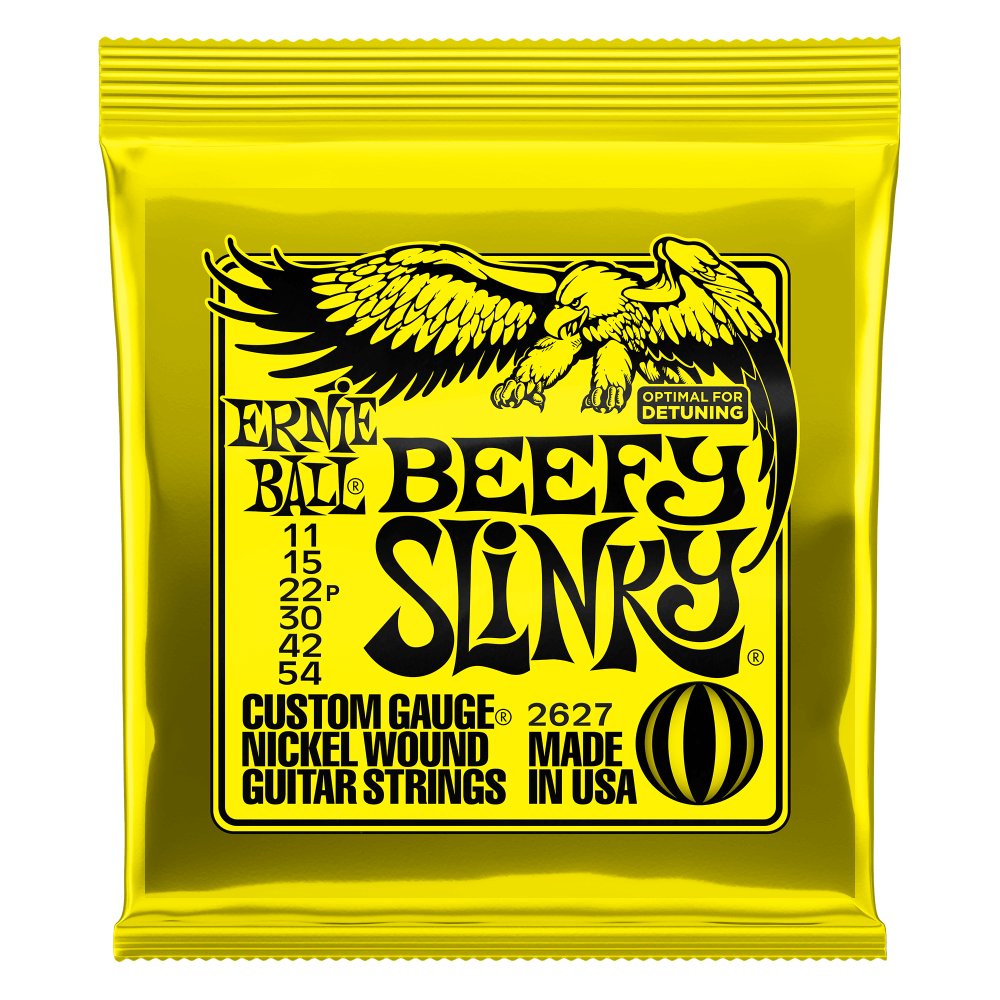
Beefy Slinky (.011–.054)
Why this one: For Drop C and below, you need the tension. Beefy Slinky gives you a .054 low string that still tunes to C without feeling dead.
Coated sets for long tracking sessions
In a studio context, multiple tracking days, heat from lights, hand sweat, coated sets buy you consistent tone over the length of a record. Elixir Nanoweb NPS, Ernie Ball Paradigm, and D'Addario XT are the three most common in this lane.
Why gauge matters more than brand for this tone
A bedroom-forum orthodoxy says metal tone requires a specific string brand. Sneap's records argue otherwise. What you need for a Sneap-adjacent rhythm-guitar tone:
- Correct gauge for the tuning. Non-negotiable. Floppy low strings destroy the entire sound.
- Fresh strings. Dead strings lose the upper-midrange clarity that makes a Sneap mix cut.
- Nickel-plated steel wrap. Pure nickel is for classic-rock voicings; stainless is for aggressive picking styles on the lead side. NPS is the center of the metal lane.
- Hex core. All of Ernie Ball, D'Addario, and Elixir use hex cores on their standard electric sets. It's the default; mention made only because round-core vintage sets behave differently and are not what this style wants.
Beyond those constraints, brand choice is a feel preference. Some players like NYXL's firmer feel; some prefer Regular Slinky's bend-friendly give. Both work.
Next steps
- If you're chasing a Judas Priest-era tone, start with metal in Eb standard.
- For the Testament / Exodus thrash side of his catalog, see thrash metal in E standard.
- For the heavier Machine Head-era material, see metal in Drop C.
- Related producer pages: Adam "Nolly" Getgood (djent-adjacent production lane), Joey Sturgis (metalcore production lane).