Drop A tuning: gauges, tension, and strings for the djent and modern metal default
Reviewed by the Change Your Strings editorial team ·
Drop A on a 7-string (A-E-A-D-G-B-E) is the dominant tuning for djent and modern prog-metal. Use .010–.059 or .010–.062 on 25.5-inch scale, .062 for Periphery-era firm feel, .059 for lighter-touch leads. Drop A on a 6-string (A-E-A-D-F#-B, technically A-E-A-D-G-C-ish with Drop-A-on-6 meaning heavy drop 2.5 steps) is non-standard, most players reach this with 7-string.
- Gibson scale (24.75")
- 13–70
- Fender scale (25.5")
- 12–68
- Baritone (27"+)
- 12–62
Gauge ranges from CYS's in-house tension-and-scale reference, built by Phil (luthier) and Wright (tension/scale).
What Drop A is for
Drop A takes the standard 7-string tuning (B-E-A-D-G-B-E) and drops the 7th string from B to A. That single-string detune accomplishes the same thing Drop D does for 6-string: it gives you chord-shape parity with a power-chord grip on the bottom two strings. A single-finger power chord on the 7th and 6th strings in Drop A plays an A5, and sliding that shape up gives you B5, C5, D5, etc. without re-fingering.
That playability combined with the low A's rhythmic punch made Drop A the dominant tuning in modern djent and prog-metal. Periphery, Animals as Leaders (earlier material), Veil of Maya, Born of Osiris, Volumes, After the Burial, Tesseract (some material), and most of the 2010-era Sumerian Records djent roster live in Drop A or Drop G# territory. The tuning's footprint is so large that "Drop A" is often assumed when a listener hears modern 7-string metal.
Tension targets
On 7-string at 25.5-inch scale, the target for the low A string is 14–17 pounds of tension, firm enough for palm-mute articulation, not so stiff that legato runs on the low string feel dead.
Recommended sets
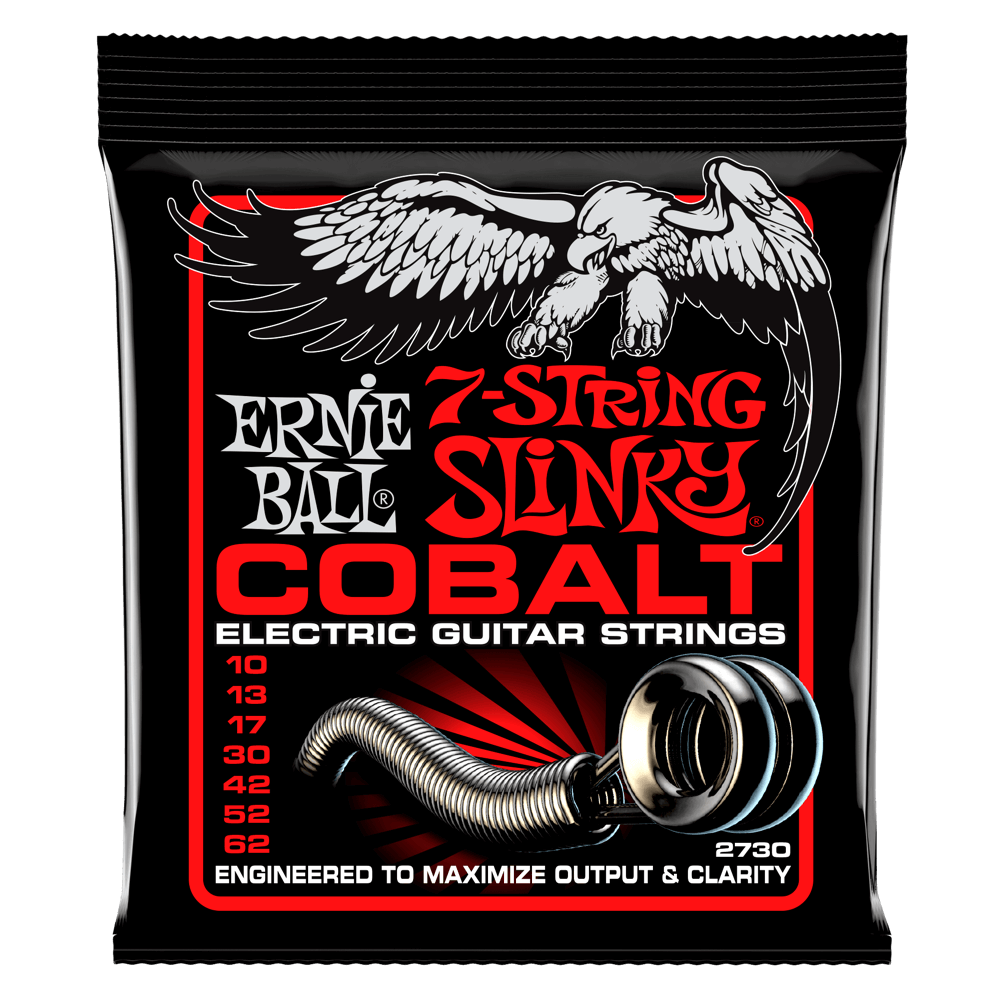
Slinky Cobalt 7-String (.010–.062)
Why this one: Mark Holcomb's documented gauge, the reference Drop A / Drop G# set. Cobalt wrap gives defined palm-mute attack that reads cleanly in dense mix contexts.
For Drop A without Cobalt: Ernie Ball Regular Slinky 7-string .010–.056 is lighter than ideal but works on longer-scale 7-strings. D'Addario NYXL 7-string in .010–.059 is the nickel-plated-steel Drop A reference. Elixir Nanoweb 7-string for coated, long-life sets.
Scale length adjustments
- 25.5" (most 7-string guitars): Default. .010–.062 is the Drop A anchor gauge.
- 26.5" baritone 7-string: Step one gauge lighter. .010–.056 or .010–.059 handles Drop A at the same tension the shorter scale gets from .010–.062.
- 27.0"+ / multi-scale: Even lighter gauges possible. Some Strandberg and Kiesel Vader 7-string players run .009–.054 on 26.5"–27" multi-scale and report the low A sitting cleanly.
Genre notes
- Djent: .010–.062 Ernie Ball Cobalt 7-string is the genre default, Holcomb gauge.
- Prog-metal (Petrucci-adjacent): Lighter gauges if the material drops to Drop A only occasionally. .010–.056 or .010–.059 work.
- Metalcore with 7-string: .010–.059 or .010–.062 depending on how rhythmically aggressive the material is.
- Extended-range rhythm work: If the song stays in Drop A or below for most of the arrangement, step to heavier gauge (.010–.064) or move to baritone scale.
Setup checklist
Moving to Drop A from Drop G# or B standard:
- Truss rod: Slight adjustment if changing gauge. No adjustment needed for a half-step retune on the same gauge.
- Nut slots: Check for binding on the low string. A .062 in a slot cut for .059 will bind.
- Intonation: Reset at the 12th fret harmonic for the low string. Lower pitch = saddle moves back.
- Pickup height: If changing gauge, recheck magnetic pull. Keep the bass-side pickup lower than the treble side.
- Bridge saddle: For floating tremolos, expect a spring-tension adjustment. Drop A on a Floyd Rose requires a claw-spring adjustment vs. B standard.
Next steps
- 7-string lane: 7-string gauge guide, Top 10 7-string players.
- Other tunings: B standard, Drop C.
- Individual rigs: Mark Holcomb, Jason Richardson, Keith Merrow, Wes Hauch.
- Strings: Ernie Ball Cobalt review.
- Producer context: Adam "Nolly" Getgood, Ermin Hamidovic.
String gauge by tuning + scale length
Safe gauge ranges by tuning across Gibson (24.75"), Fender (25.5"), and baritone (27"+) scales. A dash in any cell means that scale length isn't recommended for the tuning, not that data is missing.
| Tuning | Gibson scale (24.75") | Fender scale (25.5") | Baritone (27"+) |
|---|---|---|---|
| E Standard | 10–46 | 9–42 | – |
| Drop D | 10–52 | 10–52 | – |
| Eb Standard | 11–48 | 10–52 | – |
| Drop C# | 11–54 | 11–48 +52 | – |
| D Standard | 11–54 | 11–48 | 10–52 |
| C Standard | 12–56 | 12–56 | 12–56 |
| Drop C | 12–56 | 11–54 +56 | 11–56 |
| Drop B | 12–64 | 12–62 | 11–54 |
| B Standard | 13–68 | 13–64 | 12–54 |
| Drop A | 13–70 | 12–68 | 12–62 |
| Drop G | – | – | 13–70 |
Source: CYS in-house tension-and-scale reference, built by Phil (luthier) and Wright (tension/scale). For scale lengths between categories (e.g., 25" PRS), split the difference between the two nearest columns.
Frequently asked questions
What is Drop A?
On 7-string: A-E-A-D-G-B-E (low to high). The 7th string is dropped from B to A, giving chord-shape parity with 6-string Drop D on the bottom two strings. The top six strings remain at B-standard-7-string pitches. Drop A is the dominant tuning in modern djent and prog-metal, Periphery, Meshuggah-adjacent, Animals as Leaders earlier material, most Sumerian Records djent rosters.
What gauge for Drop A on 7-string?
.010–.059 is the minimum; .010–.062 is the modern default. Periphery's Mark Holcomb runs .010–.062 Ernie Ball Cobalt (SKU 2730) for Drop G# (a half-step below Drop A), same set works for Drop A with slightly less firm low-string feel. Jason Richardson runs .010–.059 Ernie Ball Cobalt in Drop A.
Is Drop A better than B standard for djent?
Yes, essentially, Drop A is the djent-lane default. The low A sits a whole step below B standard's low B, which gives rhythm riffs the signature open-low-string chug that defines the genre. B standard is more prog-metal-friendly (Petrucci, Loomis); Drop A is djent-friendly (Periphery, Sumerian-era bands).
Can I play Drop A on a 6-string?
Technically yes, with heavy gauges (.014–.068 custom) and baritone scale (27"+), but it's rare. Drop A on 6-string tunes the whole instrument 2.5 steps below E standard, which is structurally and acoustically unusual for a 6-string. Most players who want Drop A move to 7-string. The 6-string Drop A lane shows up in some doom and stoner material where the band wants the low-A-as-low-string character without the extra-string range.
Does scale length matter for Drop A?
Yes. 25.5-inch scale on 7-string is the default and works with .010–.062. 26.5-inch baritone 7-string lets you run lighter gauges (.010–.056) for the same low-string tension. Multi-scale 7-strings (Strandberg, Kiesel, Mayones) taper from ~25.5" treble side to ~26.5"+ bass side, the longer bass-side scale gives Drop A low string more room to breathe, the shorter treble side keeps high-string bends comfortable.
Who plays Drop A?
Periphery (Drop G# on most current material, Drop A on earlier), Mark Holcomb, Misha Mansoor, Jason Richardson, Keith Merrow, Wes Hauch, Born of Osiris, Veil of Maya, and most of the 2010-era djent roster. Drop A is the single most common tuning in modern 7-string metal, more common than B standard in 2026.